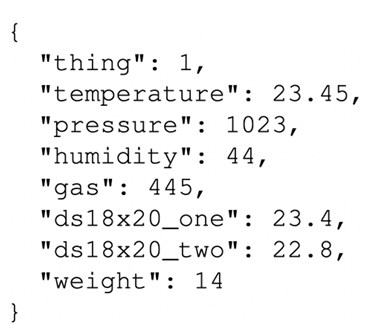
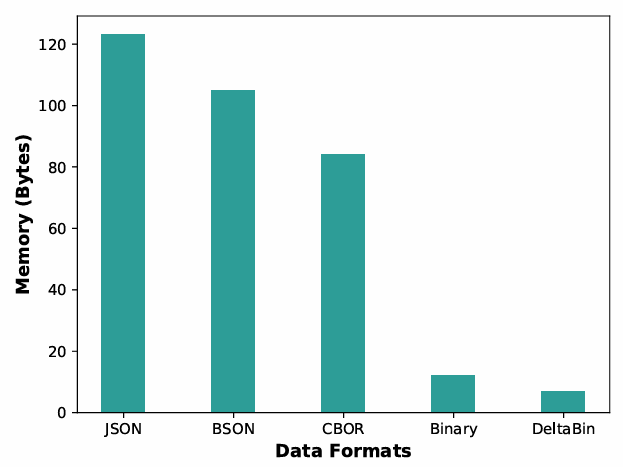
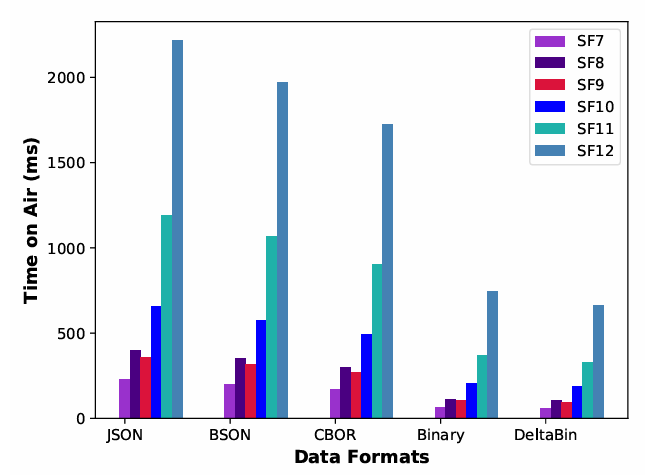
DeltaBin, a data format meant to help low-power IoT devices send information more efficiently. Instead of transmitting full sensor readings every time, DeltaBin sends only the difference (delta) between the current reading and the previous one. This is smart because many sensors—like those in the beehive monitoring system used in the study—don’t change very much from moment to moment. Sending just the delta cuts down the payload size and reduces network transmission time, which is critical for devices using low-bandwidth communication like LoRa. The researchers compare DeltaBin to formats such as JSON, BSON, CBOR, and regular binary and find that DeltaBin uses the least memory (only 7 bytes) and has the shortest Time-on-Air across all spreading factors. The data formatting can greatly boost efficiency for battery-powered IoT systems.
N. Maleki, A. Musaddiq, D. Mozart, T. Olsson, M. Omareen and F. Ahlgren,
"DeltaBin: An Efficient Binary Data Format for Low Power IoT Devices," 2023 International Conference on Computer,
Information and Telecommunication Systems (CITS), Genoa, Italy, 2023, pp. 1–5, doi: 10.1109/CITS58301.2023.10188750.